

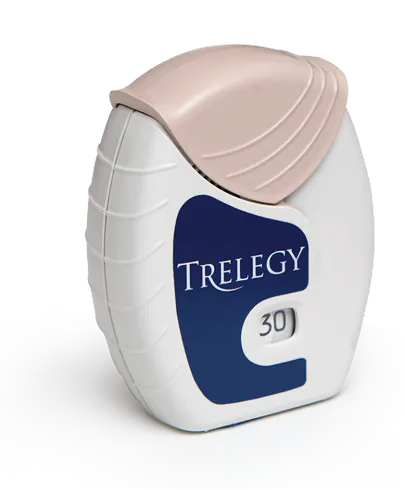


Once-daily TRELEGY is a prescription medicine used long term to treat COPD, including chronic bronchitis, emphysema, or both and to treat asthma in adults. TRELEGY 100/62.5/25 mcg is the only strength approved for COPD. TRELEGY is not used to relieve sudden breathing problems and won’t replace a rescue inhaler.
Once-daily TRELEGY is a prescription medicine used long term to treat COPD, including chronic bronchitis, emphysema, or both and to treat asthma in adults. TRELEGY 100/62.5/25 mcg is the only strength approved for COPD. TRELEGY is not used to relieve sudden breathing problems and won’t replace a rescue inhaler.
Once-daily TRELEGY is a prescription medicine used long term to treat COPD, including chronic bronchitis, emphysema, or both and to treat asthma in adults. TRELEGY 100/62.5/25 mcg is the only strength approved for COPD. TRELEGY is not used to relieve sudden breathing problems and won’t replace a rescue inhaler.
Limitations of Use
TRELEGY is not used to relieve sudden breathing problems and will not replace a rescue inhaler. TRELEGY should not be used in children younger than 18 years of age. It is not known if TRELEGY is safe and effective in children younger than 18 years of age.
- TRELEGY contains vilanterol. Long-acting beta2-adrenergic agonist (LABA) medicines such as vilanterol,
- TRELEGY contains vilanterol. Long-acting beta2-adrenergic agonist (LABA) medicines such as vilanterol, when used alone, increase the risk of hospitalizations and death from asthma problems. TRELEGY contains an ICS, an anticholinergic, and a LABA. When an ICS and LABA are used together, there is not a
- TRELEGY contains vilanterol. Long-acting beta2-adrenergic agonist (LABA) medicines such as vilanterol, when used alone, increase the risk of hospitalizations and death from asthma problems. TRELEGY contains an ICS, an anticholinergic, and a LABA. When an ICS and LABA are used together, there is not a significant increased risk in hospitalizations and death from asthma problems.
- Do not use TRELEGY to relieve sudden breathing problems. Always have a rescue inhaler with you to treat sudden symptoms.
- TRELEGY should not be used in children younger than 18 years of age. It is not known if TRELEGY is safe and effective in children.
- Do not use TRELEGY if you have a severe allergy to milk proteins or are allergic to any of the ingredients in TRELEGY. Ask your healthcare provider if you are not sure.
- Do not use TRELEGY more often than prescribed.
- Do not take TRELEGY with other medicines that contain a LABA or an anticholinergic for any reason. Tell your healthcare provider about all your medical conditions and about all the medicines you take.
- Call your healthcare provider or get medical care right away if your breathing problems get worse, if you need your rescue inhaler more often than usual or it does not work as well to relieve your symptoms.
- TRELEGY can cause serious side effects, including:
- fungal infection in your mouth or throat (thrush). Rinse your mouth with water without swallowing after using TRELEGY to help reduce your chance of getting thrush.
- pneumonia. People with COPD have a higher chance of getting pneumonia. TRELEGY may increase the chance of getting pneumonia. Call your healthcare provider if you notice any of the following symptoms: change in amount or color of mucus; fever; chills; increased cough; increased breathing problems.
- weakened immune system and increased chance of getting infections.
- reduced adrenal function. This can happen when you stop taking oral corticosteroids and start taking inhaled corticosteroids.
- sudden breathing problems immediately after inhaling TRELEGY. If this happens, stop taking TRELEGY and call your healthcare provider right away.
- serious allergic reactions. Call your healthcare provider or get emergency medical care if you get any of the following symptoms: rash; hives; swelling of your face, mouth, and tongue; breathing problems.
- effects on heart: increased blood pressure; a fast or irregular heartbeat, awareness of heartbeat; chest pain.
- effects on nervous system: tremor; nervousness.
- bone thinning or weakness (osteoporosis).
- eye problems including glaucoma, increased pressure in your eye, cataracts, blurred vision, worsening of narrow-angle glaucoma, or other changes in vision. You should have regular eye exams while using TRELEGY. Acute narrow-angle glaucoma can cause permanent loss of vision if not treated. Symptoms of acute narrow-angle glaucoma may include: eye pain or discomfort; nausea or vomiting; blurred vision; seeing halos or bright colors around lights; red eyes. If you have these symptoms, call your healthcare provider right away before taking another dose.
- new or worse urinary retention. Symptoms may include: difficult, painful, or frequent urination; urination in a weak stream or drips. If you have these symptoms, stop taking TRELEGY and call your healthcare provider right away.
- changes in laboratory blood values, including high levels of blood sugar (hyperglycemia) and low levels of potassium (hypokalemia).
- slowed growth in children.
- Common side effects of TRELEGY 100/62.5/25 mcg for COPD include: upper respiratory tract infection; pneumonia; bronchitis; thrush in your mouth and throat (rinse your mouth with water without swallowing after use to help prevent this); headache; back pain; joint pain; flu; inflammation of the sinuses; runny nose and sore throat; taste disturbance; constipation; painful and frequent urination (signs of a urinary tract infection); nausea, vomiting, and diarrhea; mouth and throat pain; cough; and hoarseness.
- Common side effects of TRELEGY for asthma include: runny nose and sore throat; upper respiratory tract infection; bronchitis; respiratory tract infection; inflammation of the sinuses; painful and frequent urination (signs of a urinary tract infection); flu; headache; back pain.